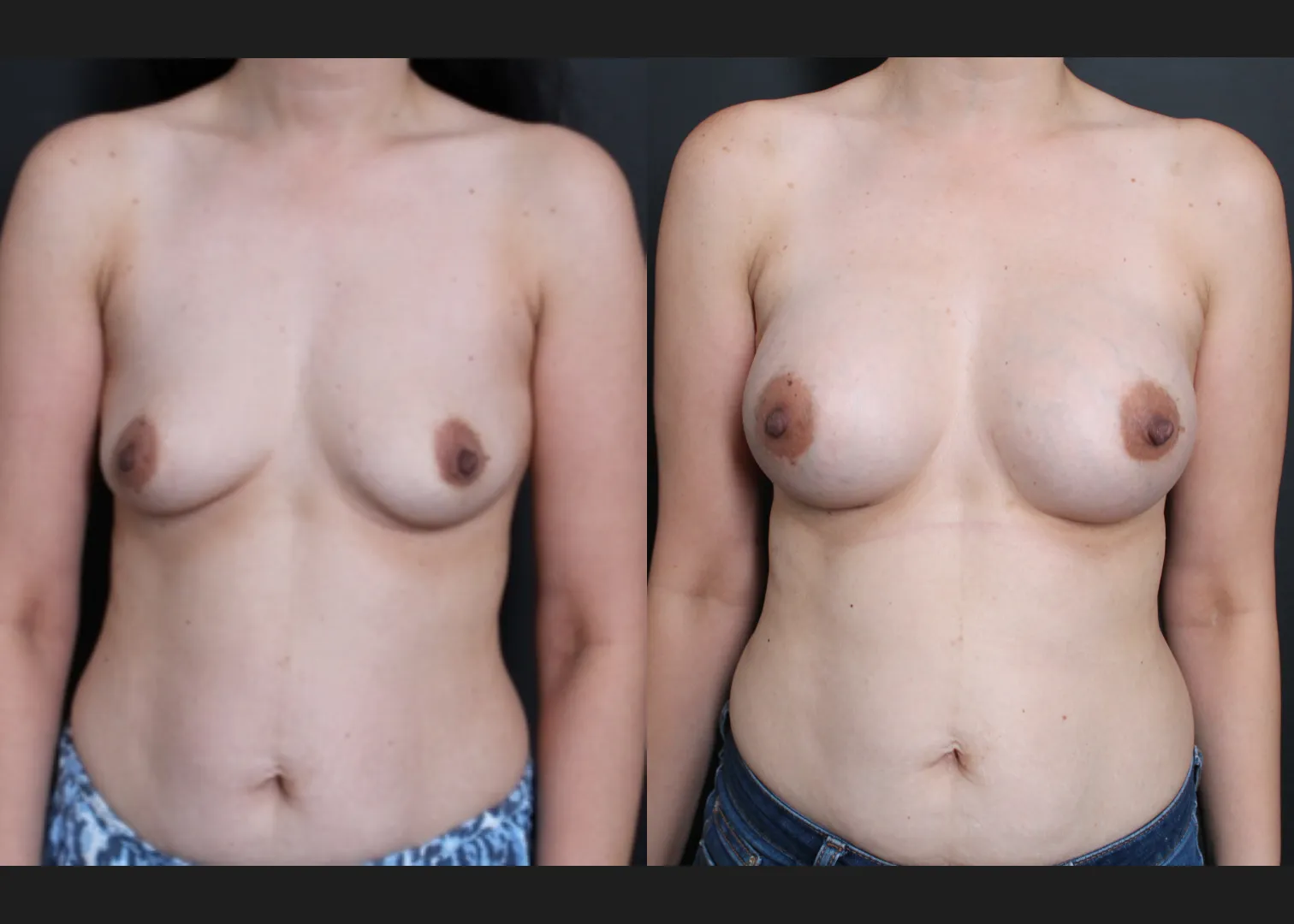
Have you ever seen a breast augmentation that almost looks like two breasts sitting on top of each other? This is often referred to as a double bubble deformity, a breast contour irregularity that can occur when the natural breast tissue, breast crease, and implant are not in harmony.
While double bubble can occur for several reasons, thoughtful surgical planning can help minimize the risk. Understanding the patient’s natural anatomy, tissue quality, breast fold, and how a particular implant will interact with those structures is an important part of creating a smooth, natural-looking breast augmentation result.
Below, Beverly Hills plastic surgeon Dr. Maryam Zamani explains what causes double bubble after breast augmentation, what it can look like, and how it can be treated.
What Is a Double Bubble in Breast Augmentation?
A double bubble occurs when the breast develops two distinct contours rather than one smooth, natural curve.
One of the most common presentations occurs when the implant sits below the natural breast crease, also known as the inframammary fold. The original fold remains visible across the breast while the implant creates a second curve below it, resulting in the characteristic “double bubble” appearance.
The inframammary fold plays an important role in defining the natural shape and lower border of the breast. For a beautiful breast augmentation result, the implant, natural breast tissue, and breast fold all need to work together.
What Causes Double Bubble?
There isn’t one single cause of double bubble. In many cases, it comes down to how the patient’s natural breast anatomy interacts with the implant and the pocket created during surgery.
Implant Position
Double bubble can occur when the breast implant sits lower than the natural breast crease.
If the implant extends below the original fold but the natural attachments of that fold remain tight, an indentation can develop across the lower breast. The implant then creates a second curve beneath it.
This is why implant position and careful management of the inframammary fold are such important considerations when planning breast augmentation.
Tuberous or Constricted Breasts
Double bubble can also occur in patients with tuberous or constricted breasts.
With constricted breast anatomy, the tissues along the lower breast can be particularly tight. If those tissues do not expand appropriately over the implant, the natural fold can remain visible and create an indentation across the breast.
For these patients, breast augmentation may require additional techniques to carefully release the constricted tissues and allow them to drape more naturally over the implant.
As Dr. Zamani explains, the goal is to allow the breast tissue to gently cover the curvature of the implant, borrowing its roundness to create a softer, more natural breast shape.
Is Double Bubble the Same as Bottoming Out?
Double bubble and bottoming out are sometimes confused, but they are not quite the same.
With double bubble, there is typically a visible crease or indentation across the lower breast with additional implant fullness underneath it.
Bottoming out occurs when the implant descends too far on the chest, creating excessive fullness in the lower breast. As a result, the nipple may appear higher on the breast mound.
Although both can involve the position of the implant and lower breast fold, determining exactly what is causing the contour irregularity is important because treatment may be different.
What Is a Waterfall Deformity?
Another breast augmentation concern that can resemble a double bubble is known as a waterfall deformity.
In this situation, the relationship between the implant and breast tissue is essentially reversed. The implant remains relatively high while the natural breast tissue begins to descend over it, creating an elongated or oblong breast shape.
Dr. Zamani often sees this in patients who have developed some degree of breast laxity from pregnancy, breastfeeding, weight fluctuations, aging, or their natural tissue distribution. It may also occur in some patients with implants placed partially or completely underneath the muscle.
The result can look as though the natural breast tissue is “falling” off the implant.
Although double bubble and waterfall deformity can appear similar, understanding what is actually causing the breast shape is essential when planning a correction.
Can Double Bubble Be Prevented?
Thoughtful surgical planning can play an important role in reducing the likelihood of double bubble and creating a smooth, natural-looking breast contour.
When planning breast augmentation, Dr. Zamani carefully considers the natural breast fold, breast width, skin and tissue quality, nipple position, existing laxity or asymmetry, chest wall anatomy, and implant dimensions. These considerations are especially important for patients with a tight breast fold or constricted breast anatomy, where a more tailored surgical approach may be needed.
As Dr. Zamani explains, “A lot of times, it can be prevented by meticulous planning and utilizing a surgical technique specific to that patient’s anatomy.”
Can Double Bubble Be Fixed?
Yes. Double bubble can often be corrected with breast revision surgery, but the appropriate treatment depends on what caused it in the first place.
For some patients, correction may involve repairing or repositioning the breast fold or adjusting the implant pocket. Others may benefit from a different implant size or position, release of constricted breast tissue, fat grafting, or a breast lift when laxity or sagging is contributing to the breast shape.
Revision breast surgery is highly individualized. Rather than simply replacing an implant, Dr. Zamani evaluates the relationship between the implant, breast tissue, scar tissue, breast fold, and chest anatomy to determine what needs to be addressed to create a more balanced contour.
How Do I Know If I Have Double Bubble?
The most recognizable sign of double bubble is a second crease or indentation along the lower breast, making it appear as though there are two separate breast contours.
That said, not every unusual contour after breast augmentation is a double bubble.
Breast shape changes considerably during the early stages of recovery as swelling resolves and implants settle. If you notice a persistent crease, an implant that appears unusually low, or a breast contour that does not improve as you heal, an in-person examination can help determine what is happening.
Frequently Asked Questions About Double Bubble
Can Double Bubble Go Away on Its Own?
If you are early in your breast augmentation recovery, temporary changes in breast shape may improve as swelling subsides and the implants settle. A true double bubble that persists once the breast has healed, however, may require surgical correction.
Are Tuberous Breasts More Prone to Double Bubble?
Patients with tuberous or constricted breast anatomy can have a particularly tight lower breast and inframammary fold. Breast augmentation in these patients may require specialized techniques to release the constricted tissues and allow the lower breast to expand naturally over the implant.
Can You Fix Double Bubble Without Removing the Implants?
Possibly. Double bubble correction does not necessarily mean permanently removing your breast implants. Depending on the cause, Dr. Zamani may be able to adjust the implant pocket or breast fold, reposition the existing implant, or recommend exchanging it for an implant better suited to your anatomy.
Breast Implant Revision for Double Bubble in Beverly Hills
Breast augmentation is about much more than choosing an implant size. Creating a beautiful, natural-looking result requires an understanding of how the implant will interact with the patient’s existing breast tissue, breast fold, skin, and chest anatomy.
This becomes even more important in revision breast surgery.
At her boutique Beverly Hills practice, Dr. Maryam Zamani takes a highly individualized approach to breast augmentation and breast implant revision, carefully evaluating the underlying cause of concerns such as double bubble, bottoming out, implant malposition, and waterfall deformity before developing a treatment plan.
If you are unhappy with the shape or position of your breast implants, we invite you to schedule a private consultation with Dr. Zamani. She will evaluate your previous breast augmentation, listen to your concerns, and discuss the options available to create a more balanced, natural-looking breast contour.