Above the Muscle vs. Below the Muscle: Breast Augmentation

By Dr. Maryam Zamani

One of the most important — and most misunderstood — decisions in breast augmentation isn’t the implant itself, but where it’s placed. Patients often come to me having heard the terms “over the muscle” and “under the muscle,” but the reality is more nuanced, and getting this decision right is central to how natural, comfortable, and long-lasting the results will be.

Here’s how I think through implant pocket placement with my patients.

Above the Muscle: Why Subfascial Is Not the Old “Over the Muscle”

When patients hear “over the muscle,” many picture the older subglandular technique, where the implant sits directly beneath the breast tissue with no intervening layer. Older studies linked this approach to higher rates of complications like capsular contracture, visible implant edges, and rippling — largely because the implant sits in direct contact with breast tissue and the milk ducts, which naturally carry some bacteria.

Modern techniques have moved well beyond this. When I talk to patients about placing implants above the muscle, I almost always refer to the **subfascial plane** — a meaningfully different and more refined approach.

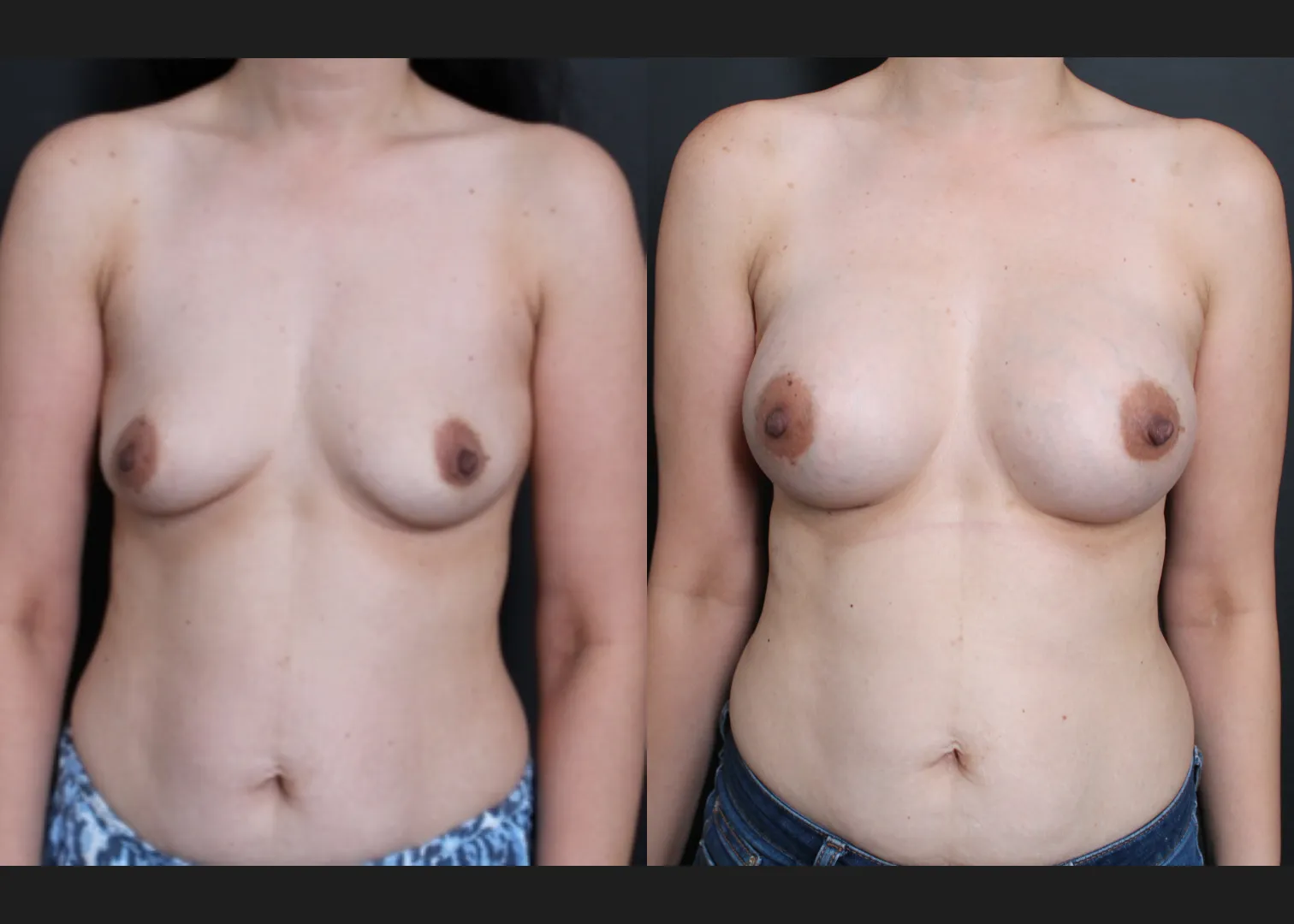
Instead of dividing the pectoralis major muscle, this technique elevates the fascia — a thin but strong connective tissue layer that encases the muscle — off the muscle’s surface. The muscle itself stays completely intact and undisturbed, while the implant still benefits from a distinct separating layer between it and the breast tissue, along with some of the structural support the muscle provides. This is also known as **muscle-preservation breast augmentation**, since it maintains full shoulder strength, stability, and muscle function.

What the Data Actually Shows

The complication concerns associated with older “over the muscle” techniques come from literature that’s decades old and doesn’t reflect today’s advances — no-touch surgical technique, antibiotic irrigation, the Keller funnel, and newer-generation implants with significantly lower capsular contracture rates. With subfascial placement specifically, current data shows minimal difference, if any, in capsular contracture rates compared to submuscular placement.

The Advantages of Subfascial Placement

Better control over cleavage. Because the implant isn’t constrained by where the pectoralis muscle attaches to the sternum, I have far more freedom to bring implants together in the midline and create fuller, closer cleavage. This matters most for patients with wider-set breasts who want a fuller, more central décolletage — something that’s inherently limited when the implant sits under the muscle.

No constant muscle pressure on the implant. When an implant sits under an active pectoralis muscle, that muscle continuously pushes down and out on it. Over time, this can contribute to implants settling lower and appearing heavier or more “saggy.” Subfascial placement eliminates this ongoing pressure.

No animation deformity. Because the muscle is never divided, there’s no movement of the implant when the pectoralis contracts — something that can be quite noticeable in athletic patients with more developed chest muscles, sometimes even during everyday movement, not just at the gym.

Below the Muscle: Understanding Dual Plane

I also discuss submuscular, or **dual plane**, placement with my patients when appropriate. It’s worth clarifying a common misconception here: in aesthetic (non-reconstructive) breast augmentation, implants are essentially never placed *fully* under the muscle. At minimum, the pectoralis major is divided along its lower border to create room for the implant — this partial coverage is what’s called dual plane placement.

Full muscle coverage is really a reconstructive technique, used when a tissue expander is placed after breast tissue has been removed and needs complete coverage, often with an added layer of scaffold material like AlloDerm or mesh to give the muscle room to stretch. That’s a different clinical situation entirely from cosmetic augmentation.

When Dr. Zamani Recommends Dual Plane

Saline implants

These have less structural integrity than silicone and are prone to visible rippling, so muscle coverage is necessary to help minimize this.

Very thin patients with minimal breast tissue

In cases where there isn’t enough natural tissue to camouflage the implant, roughly a half to one centimeter of muscle coverage can help create a more natural-looking result — though newer, more naturally shaped implants are increasingly allowing us to place implants safely above the muscle even in thinner patients.

Desired upper pole shape

With subfascial placement, larger or higher-profile implants can create more roundedness at the top of the breast — which many patients actually want. Dual plane placement tends to create a more gradual upper pole slope, though a sufficiently large or high-volume implant can still produce a rounder look even under the muscle.

How Dr. Zamani Decides: Matching the Plane to the Patient

For most of my patients — particularly those who are active and want to preserve full shoulder strength and muscle function, which I find is increasingly important to modern patients — I recommend the subfascial approach. It offers a safety profile comparable to, if not better than, dual-plane placement, along with the aesthetic advantages described above.

A few anatomical situations shift my recommendation toward subfascial specifically:

Low breast footprint. Some patients have breasts positioned naturally lower on the chest wall relative to where the pectoralis muscle sits. In these cases, a submuscular implant can be held artificially high by the muscle while the breast tissue itself sits lower — creating a double-bubble or waterfall deformity. Subfascial placement allows the implant to sit where the breast tissue naturally is, for a more cohesive result.

Tuberous breasts. Subfascial placement often works better for constricted or tuberous breast shapes. It helps recruit and stretch the tissue in the lower pole — the area of constriction — and allows the implant to sit directly behind the glandular tissue, encouraging it to splay out more evenly rather than having that effect blunted by an intervening muscle layer.

Mild early ptosis (sagging). For patients with early, mild breast droops who want to avoid a lift, subfascial placement lets the implant sit directly behind the existing breast tissue. This means gravity, aging, and weight changes affect the implant and the natural tissue similarly over time, rather than the tissue gradually slipping off a muscle-held implant — again, avoiding a waterfall or double-bubble effect.
Recovery Differences

Recovery also factors into this decision. Because the muscle isn’t divided in subfascial placement, recovery tends to be considerably easier, and implants generally settle into their final position more quickly.

With dual plane placement, patients typically experience more tightness in the first few weeks as the divided muscle relaxes and adapts to the implant beneath it. Implants placed under the muscle also tend to sit higher initially, held up by the muscle, and often require implant massage to help them settle — or “fluff out” — into their intended position over time.

Which Implant Placement Option Is Best for Me?

There’s no single “best” pocket for every patient — the right choice depends on your anatomy, activity level, implant type, and aesthetic goals. However, the field has moved well past the old over-the-muscle-versus-under-the-muscle framing. With modern subfascial techniques, most patients can now achieve natural, long-lasting results while preserving full muscle function — something that simply wasn’t possible with older approaches.

If you’re considering breast augmentation and want to talk through which approach is right for you, I will be happy to discuss your options during a consultation.

Introduction

Arrange Your Consultation

Find out more about your breast implant placement options with a consultation at Zamani Plastic Surgery. Contact us today to arrange your personalized breast augmentation consultation at our Beverly Hills facility.

Rediscover

Timeless Beauty

Schedule a consultation

Gallery Consultation
Call Email Gallery