- Home
- Face
- Breast
- Breast Augmentation
- Breast Lift (Mastopexy)
- Breast Augmentation + Lift
- Breast Implant Removal
- Breast Implant Revision
- Capsular Contracture Treatment
- Fat Transfer Breast Augmentation
- Composite (Hybrid) Breast Augmentation
- Motiva Breast Implants
- Ozempic Breast
- Preservation Breast Augmentation
- Tuberous Breast Correction
- Nipple Reshaping
- Breast Asymmetry Correction
- Gynecomastia
- Body
- Vaginal Rejuvenation
- Skin
- About
- Gallery
- Resources
- Contact
If you’re considering labiaplasty, you’ve likely come across two surgical techniques: the trim technique and the wedgetechnique. Online, it’s common to see one presented as “better” than the other, but that’s an oversimplification.
In reality, there is no universally superior approach. The best technique depends on your anatomy, your goals, and your surgeon’s experience.
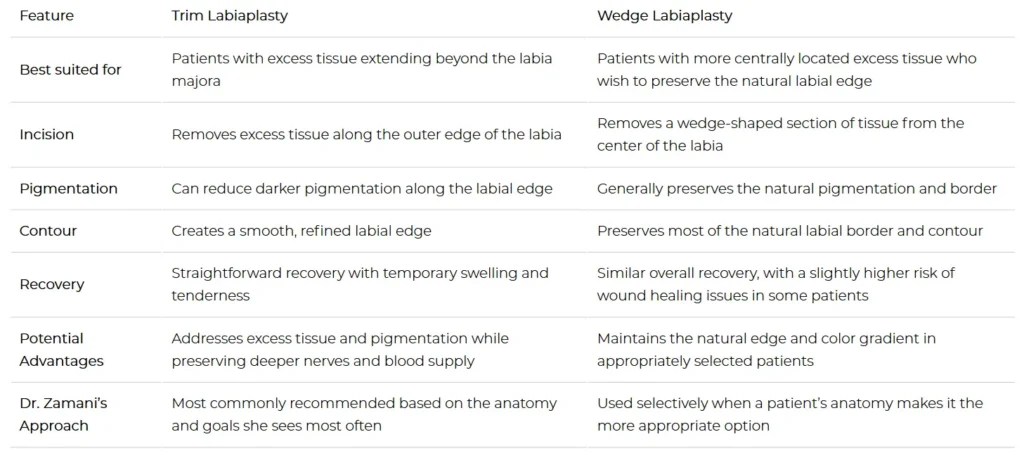
At her Beverly Hills practice, dual board-certified female plastic surgeon Dr. Maryam Zamani believes that every labiaplasty should be customized to the individual patient. While she performs the trim technique in the majority of cases because it best addresses the concerns she sees most often, she also recognizes that certain patients may benefit from a wedge labiaplasty instead.
The decision isn’t about choosing the most popular procedure. It’s about choosing the right procedure for you.

Every Patient’s Anatomy Is Different
One of the reasons labiaplasty is such an individualized procedure is because no two patients have the same anatomy.
The labia naturally vary in size, shape, contour, thickness, and pigmentation. Even the right and left sides often differ from one another. These natural variations are completely normal, which is why there is no single “ideal” appearance.
During every consultation, Dr. Zamani carefully evaluates each patient’s anatomy before recommending a surgical technique. She also spends time understanding what concerns the patient most. Some women are primarily bothered by excess tissue extending beyond the labia majora, while others are more concerned about asymmetry, darker pigmentation along the edges, discomfort during exercise, irritation in clothing, or a combination of functional and cosmetic concerns.
Those conversations are just as important as the physical examination when creating a personalized surgical plan.
Why Dr. Zamani Performs the Trim Technique Most Often
Although every labiaplasty is tailored to the individual patient, Dr. Zamani performs the trim technique in the majority of cases because it aligns with the goals she sees most frequently.
Many patients are looking to reduce excess tissue that extends beyond the labia majora while creating a smoother, more refined contour. Because the outer edge of the labia is often naturally darker in pigmentation, the trim technique can also improve color uniformity for patients who are bothered by excess pigmented tissue.
Another reason Dr. Zamani often recommends the trim technique is its ability to preserve the natural function of the labia while creating an elegant, balanced result. By removing excess tissue along the outer edge, the procedure generally preserves the deeper nerves and blood vessels responsible for sensation and healing.
For appropriately selected patients, this approach offers a predictable recovery, a low risk of complications, and natural-looking results.

When a Wedge Labiaplasty May Be the Better Choice
Although the trim technique is appropriate for many women, it is not the right choice for everyone.
In some patients, excess tissue is concentrated more centrally rather than along the outer edge. In these cases, removing a wedge-shaped section of tissue from the middle of the labia may better preserve the existing contour and natural pigmentation of the labial border.
The wedge technique can also be a good option for patients who specifically wish to maintain the natural transition in color that often exists along the labial edge.
Rather than applying the same technique to every patient, Dr. Zamani selects the approach she believes will create the most natural and balanced result based on each patient’s anatomy.
Recovery Considerations
Recovery after trim and wedge labiaplasty is similar in many respects. Both procedures involve temporary swelling, tenderness, and a gradual healing process over several weeks.
There are, however, some differences.
Because the wedge technique requires a deeper incision through the central portion of the labia, it may carry a slightly higher risk of wound healing issues in certain patients. The trim technique removes tissue along the outer edge instead, allowing many of the deeper supporting structures to remain undisturbed.
Swelling can occur with either procedure. In some cases, swelling may be more noticeable after a trim labiaplasty simply because a larger surface area has been treated. Overall, however, recovery is comparable for most patients, and careful postoperative care plays an important role regardless of which technique is used.
Natural-Looking Results Depend on More Than Technique
Patients often assume that choosing the “right” technique is what determines the final result.
In reality, the quality of a labiaplasty depends far more on thoughtful surgical planning, meticulous technique, and an individualized approach than on whether a trim or wedge procedure is performed.
Both techniques are capable of producing beautiful, natural-looking, long-lasting results when selected appropriately and performed by an experienced plastic surgeon.
Rather than focusing on which procedure is considered better online, patients should focus on finding a surgeon with the experience and judgment to determine which approach is best suited to their unique anatomy.
Choosing the Right Labiaplasty Technique
Choosing between a trim and wedge labiaplasty is not a decision that should be made based on internet forums or social media discussions alone.
During a private consultation, Dr. Maryam Zamani carefully evaluates each patient’s anatomy, listens to their goals, and recommends the surgical technique she believes will provide the safest procedure and the most refined, natural-looking result.
As a dual board-certified female plastic surgeon serving Beverly Hills and the greater Los Angeles area, Dr. Zamani performs personalized labiaplasty with a focus on comfort, function, and elegant surgical outcomes tailored to every patient.
Medically Reviewed By
Maryam Zamani, MD
Dual Board-Certified Plastic Surgeon
American Board of Plastic Surgery
Royal College of Physicians and Surgeons of Canada
Last reviewed: July 2026